
HMNS Exhibits 4.5-Billion-Year-Old Meteorite that Crashed in Spring, Texas
From Outer Space to Outer Loop: Fall To Earth brings visitors face-to-face with the space rock that pierced Spring, TX home
When Spring resident Sherrie James heard a thunderous boom, she had no idea a 4.5-billion-year-old meteorite had just crashed through the roof of her home. What began as a mysterious explosion heard across Southeast Texas has become one of the most remarkable, documented meteorite falls in recent Texas history.
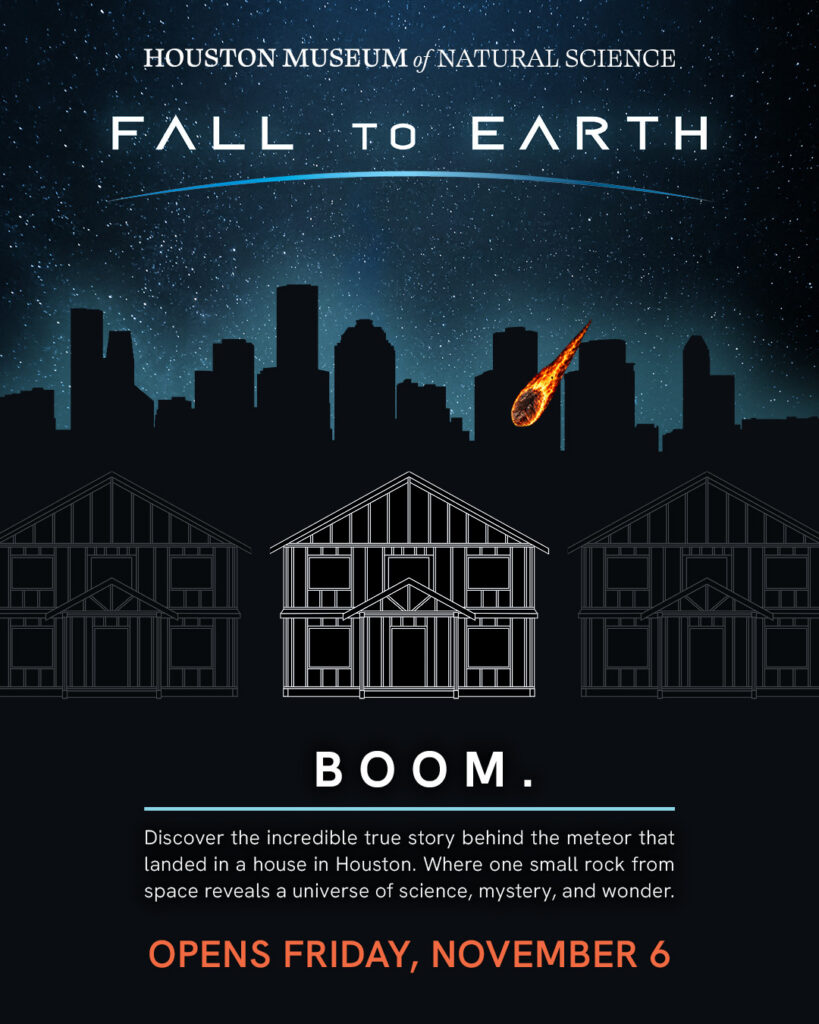
Now, the Houston Museum of Natural Science (HMNS) is bringing that extraordinary event to life in its newest exhibition, Fall To Earth. At the center of the exhibition is the actual meteorite that landed in James’ home on March 21, 2026.
The space rock tore through the roof, traveled through the upstairs bedroom and ultimately came to rest near her daughter’s bed. The Ponderosa Fire Department initially investigated whether the object might have been debris from an aircraft. Its unusual weight and appearance, however, quickly pointed to something far more extraordinary.
“It’s just exciting to think of where it’s been and how far it’s traveled,” James said of the meteorite. “That little thing has traveled by planets and stars, there’s no telling how far it’s come. So, it’s very exciting. I just feel blessed it came to see me.”
Since the fall, 19 meteorite fragments have been recovered throughout the Houston area. NASA scientists also helped reconstruct its journey through Earth’s atmosphere. More than a display of an extraordinary object, the exhibition places visitors inside the moment of one of the most remarkable natural events ever experienced in the Houston area.
“This is one of those stories that almost seems impossible until you see it for yourself,” said Dr. Carolyn Sumners, VP of Astronomy at HMNS. “A 4.5-billion-year-old fragment of our solar system’s original formation crashed through the roof of a Houston-area home. That’s not something you expect to happen in your own neighborhood. This exhibition allows visitors to experience both the science behind the event and the remarkable human story that unfolded.”
From Space to Spring, TX
Scientists estimate the original meteoroid entered Earth’s atmosphere at nearly 35,000 miles per hour. The brilliant fireball was visible across much of Texas, with more than 180 eyewitnesses reporting sightings from as far away as Dallas-Fort Worth, Austin and Rockport. Weather radar even tracked fragments as they fell toward Earth.
As the meteoroid broke apart high above the Houston area, it released energy equivalent to approximately 26 tons of TNT, creating the powerful pressure wave that rattled homes across Southeast Texas and sent residents searching the skies for the source of the mysterious sound.
Most of the original meteoroid burned away before reaching the ground. The recovered meteorite dates to the birth of our solar system 4.5 billion years ago, offering scientists a rare opportunity to study material older than Earth itself. Classified as an ordinary chondrite, the meteorite provides scientists with valuable clues about the materials that formed our solar system.
ADMISSION INFORMATION
Fall To Earth is free and will be on display beginning November 6. For more information, visit www.hmns.org or call (713) 639-4629.